This weekend, I joined our Tk group on the third of three trips made over the last month. We traveled to Ba'kelalan, a town in the Kelabit highlands in the Sarawakian part of the "Heart of Borneo." These highlands are most famous for their fragrant rice varieties (Yes, It's is all about Food here in Sarawak), apples, and the Lun Bawang people, an indigenous ethnic group known in the past for their superior warriors (including, yes, you guessed it...Headhunters). Ba'Kelalan is thought by many as Borneo's last Shangri-La, with serene, mostly undisturbed rainforests. So I was stoked for this trip.
Our agenda on this trip was related to a very important drug lead, as well as some of the complicated issues that are raised whenever biomedically promising natural products are found to have commercial potential. The story behind this is long and not entirely clear, but some years ago, an Australian group, in collaboration with Sarawak Forestry Dept., found in Ba'Kelalan this tree, Aglaia foveolata, whose extracts had super-strong anticancer properties. The active compound was found to be Silvestrol, a very complicated molecule that scientists have said is "unprecedented in nature." Sarawak Forestry patented the use of this plant and its components for anticancer (Leukemia specifically) applications, and later on passed it (the patent) on to Sarawak Biodiversity Centre (since it only got opened up in 2000, and Research and Development program really only started in 2006). So now SBC is responsible for the research and collaborative efforts to develop silvestrol into a clinically used cancer drug.
Of course in telling this story, I've glazed over the actual people from whose land the trees were cut to accumulate enough material for the extracts and experimental work. These Lun Bawang never before used this plant to treat cancer (they used it only to treat stomach ulcers, a seemingly different application that might provide insight into how the drug Silvestrol kills cancer cells) so the Intellectual Property issues here are fairly straight forward. It was only after the assays in the lab were conducted that the anticancer uses were discovered. But, the issue is that the plant was originally collected from someone's land, without prior approval from that landowner. Although the plant grows in others places (even, it turns out, near SBC itself), had that first one not been collected from this area, its anticancer use may not have been known. That's at least the argument of some of the Lun Bawang, who are expecting to reap some of the financial benefit of the drug if it does become commercialized. This issue is not as obviously clear as some other cases, when pharma companies have taken a plant that the people used medicinally (and conveyed this use to the company, inciting the research itself) and then developed the plant (or compounds thereof) for the exact treatment the people used it for. The people would not receive the financial benefits of this commercialization, which trampled on their IP rights, and often failed to even mention their key contributions to the drug's development.
In the case of Silvestrol, the potentially valuable use of the plant for extracting the anticancer drug was never previously known by the people. The people in the community had some serious misunderstandings of the whole situation, and the negotiations that took place at Ba'Kelalan this weekend were meant to clarify all of this, so that the people would no longer be mistakenly angry with us, and actually help facilitate the important efforts to develop an effective treatment for a notoriously untreatable disease. Basically the people there were under the impression that SBC had already commercialized the drug and were making bank on it. Untrue- SBC's not even close to that and are in pretty early stages, not yet ready for clinical trials. So they thought we were collecting more of this plant in order to extract and sell off the compound, without paying back the community at least for taking their own biological resources. The issue stems for poor communication between the community's leaders and the rest of the people, since in past trips, our TK group did tell the leaders about the progress of the research. This info just never found its way to the rest of the community.
So basically TK organized a community-wide meeting in what's a lot like a Town Hall, and set out to fully inform the people that we weren't the 'bad guys.' At the end, everyone was really supportive of what we were doing and vowed to help in any way they can.
The other part of our trip involved actually hiking around, collecting some Aglaia samples (to check on the anticancer activity of some new trees, as well as the old ones we knew previously worked), and checking on their overall health. Since after all, we will be needing hundred of Kilos of this stuff in order to get enough of the drug for the seemingly endless testing left to be conducted.
My purpose for being on the trip (aside from tagging along to observe the negotiations, enjoy the fragrant rice, and soak in this beautiful place) was to collect small Aglaia samples for endophyte isolation. That is, plants are known to harbor these symbiotic microbes, and Aglaia should be no different. And who knows, maybe the microbe(s) is/are involved in the plant's production of Silvestrol. That was, after all, the case in the Pacific Yew Tree, which produces the 'blockbuster' (for no good reason, since it is no more specific than any other chemotherapy) cancer drug Taxol.
As for the experience of hiking itself, it wasn't pretty. The heavy rainfall had made the ground extremely muddy, so my shlep uphill to the Aglaia trees was slow and not without many slips. I really do not know the first thing about trekking in the mud, and that has become very apparent to me on this trip. Everyone else managed to finish the hike with minimal mud stains on their shoes and of course squeaky clean above the foot. I, on the other hand, had shoes so caked in mud that one could have made a mud model based on it. No site on my body was protected, as I found mud stains on the inner side of my eyeglasses.
And then there were leeches, as one would expect in any jungle here after rainfall. These leeches traveled far and wide across my body. A local pointed out that my ass was bloody, and indeed my upper butt was still draining blood from a leech bite. Also these leeches care little about muddy blood, since they even attacked my legs, which were blanketed in mud. Bloody and muddy. That's how my weekend went.

Life feels sometimes like a dream. We meander through it, totally oblivious to it's many wonders, which we can unlock if we were to gain that awareness and become cognizant of it's dreamlike nature. This blog chronicles some of my journey to becoming fully lucid, to figuring "it" out, and taking any interesting detours that come my way. It all started with some rainbow flavored ice cream in Europe and a 10 month stint in Borneo. The jungles call to me...
Wednesday, February 23, 2011


Friday, February 18, 2011
On the evolving industry of ecotourism in Sarawak
Over the past few months in Sarawak, I've engaged in numerous conversations with ex-pats and tourists about Sarawak's many attractions, from the Mulu cave systems hidden deep in the earth, to the Kelabit highlands with its kampungs nested atop rugged Bornean mountain ranges. Finally, what I've discovered from these talks has melded with my direct observations, and begun to shape my view that Sarawak's kampung identity and ecotourism industry are changing (and converging) with the unceasing momentum of a monsoon shower. There is a trend in Sarawak toward developing more ecotourism opportunities, with options like camping in national parks, or kampung homestays. These homestays are surging in popularity due to the idyllic appeal of spending time with the people "of the jungle" in their jungle (and the recognition that they might possess the deepest understanding of the rainforest's mysteries and wonder).
Increasingly, some kampungs are trying to incorporate ecotourism into the fabric of their village's daily activities. On one hand it's great that communities can find ways of using what they already have to generate some revenue, meanwhile helping foreigners to become more aware of their lifeways and incredibly biodiverse environment. On the other hand, kampungs risk losing some of their identity trying to cater to the prototype tourist. Maybe they used to go hunting for wild boar in order to feed their families, but now there could be a concern that doing so will not provide enough food to supply their visitors. So maybe they start buying canned or otherwise preserved foods, and might give up on hunting and the long process involved in roasting the boar. Eventually this just becomes the norm and cooking a hearty meal from freshly caught boar becomes a thing of the past.Yes, I'm generalizing a bit, and yet these types of changes are becoming all too common, though sometimes not from their involvement in homestays, but instead from the mere pressures of an encroaching modernized world.
These ethnic groups take great pride in their connection to the jungle, and the resulting knowledge they have of the jungle's many secrets and hidden gems. In my experience learning of the vast ethnobotanical knowledge these people possess, it has also come to my attention that the people are increasingly trying to create herbal gardens, consisting of their most commonly used plants, within their kampung. Actually I joined our TK group on a trip to the Penan kampung, Long Iman, in order to help the village set up their garden, which I want to note was their choice and we were doing our part to facilitate their efforts (It's important to make this distinction, since some might draw the wrong conclusions that government agencies are trying to pressure the communities to turn to herbal gardens, and this isn't true, as far as I know). Though part of the intention of this effort was to avoid dangerous and tedious treks in search of some of these plants, another aim of the kampung's was to attract more tourists visiting Mulu National Park to come to Long Iman for guided homestays. Though I definitely see the merits of such a garden in the scheme of things, I also got to thinking about the implications of this garden for the identity of the ethnic group and the kampung itself.
Perhaps by cultivating these plants close to home, the people slowly lose a bit of their connection to the jungle by not having to maneuver through the rainforest in search of an essential herb. Moreover, they might feel like they have to modernize their kampung for tourists to be comfortable enough to visit. This means even further loss of the original kampung's identity. And in the end of the day, this 'jungle bed and breakfast' model can actually put off some tourists, who want an 'authentic' kampung experience. I've heard this complaint of some tourists, that some kampung homestays are made for tourists and just feel very manufactured. What the non-touristy tourists want now is something spontaneous, to just randomly run into a kampung and have the community invite them for an intimate stay with them.
But then again, the kampungs aren't there to fulfill some poetic tourist vision of the perfect jungle homestay. They are trying to make a revenue, so they can try to live, to survive, adapt, and even thrive in a changing landscape with the modern world knocking at their doorstep. Since now they have to find a way to pay taxes, and now their kids are growing up with the knowledge that other kids in more urban settings have ipods to listen to. And what parent doesn't want to give their children the best chance of living long and healthy lives (not via ipods, but other technology like water filters or even electricity). Moreover, if these people don't cultivate their most precious herbs, they might just lose them for good when the next logging road is made, or the next Ritz Carlton is built upstream.
So I would say it is unfair how some tourists speak harshly of these homestays, as if these people have an obligation to retain their old way of life just to display to visitors like them. Their kampung is not an insect forever preserved in amber for the delights of tourists, but rather a living, breathing, growing animal, subject to the dynamic adaptations necessary to make it in a harsh variable environment. This means that sometimes cultural preservation takes a backseat to development. I also would hope kampungs find ways to show off their true selves and boast every aspect of their ethnic identities, even if it currently includes a morning episode of Spongebob Squarepant. Even if there is now a satellite dish around, it doesn't mean the character of the people has to change that much. That's what I want to be true, but then again, I grew up with DirectTV.
Photography Mentorship: The Secret is in their Eyes
A few weeks back, I found out that our TK group is headed to a Penan Kampung in the Mulu National Park area. It worked out perfectly for me, because I wanted to join them to observe the traditional knowledge documentation work in action, and because I was already making a trip out to Sibu, then was invited by my colleague, Eunice, to stay in Miri with her Sister and Brother in-Law for a few days, before heading over to Mulu for a 3 day stay at this village. After that, the plan is to actually see the incredible Mulu National Park, with its cave systems boasting some of the deepest cave chambers and longest, most intricate, underground systems on the planet. Eunice arranged for me to stay with her Brother-in-law, Robert, because he is a professional wedding photographer, and was willing to take me out for a photography trip. How cool!!!
I took a hot, sweaty, crowded, and unforgivingly bumpy bus from Sibu to Miri, where Eunice greeted me, and took me back home for yet another Chinese New Year binge. Delicious, again. Very similar types of dishes and desserts.
I also noticed that Eunice's mom was cleaning some bird's nest of its feathers, in order to prepare a soup from this very much Chinese delicacy. Unfortunately did not have a chance to try this out, though the concept of eating bird saliva and mucus doesn't quite make my own mouth water.
Eunice brought me to the Miri City Fan, a beautiful park in the center of the city. Chinese New Year performances and festivities were in peak form there, and the city fan was packed to the brim. Got to see a whole display of the famous Chinese New year Lions in a diverse set different looks. Also there were some pretty stunning scenes of fountains, with a mosque in the backdrop, of seahorse statues (the symbol of Miri) among other sights. Eunice was super patient with me, while I set up the tripod for some long exposure shots (it was around sunset), and I tried to show my appreciation by taking some shots of her. Win-Win.
For dinner, Eunice took me out to this fantastic restaurant, Mr. Ho's Fine Foods, where I savored my Roast Pork with Apple sauce. Nom Nom Nom Nom. She also drove me around Miri, showing me the ginormous estates of Miri's timber and oil oligarchs. And then it was back to her sister's home. I got to chat with Robert, and we had a good talk about my research, how to learn photography without formal training, Malaysian Chinese resentment (not an uncommon topic, if you remember my Sibu experiences), and a recent trip he made to Semporna, Sabah, where the ethnically Philippine 'Sea Gypsies' continue to be refused any type of acknowledgment by the Malaysian government.
The next morning, we met up with Robert's other friend and fellow photographer extraordinaire, Eric (Itemo). The plan was to head over to Niah Cave, the site of past archaeological studies investigating the earliest human occupation in Borneo (http://www.abc.net.au/science/slab/niahcave/history.htm). In fact, an excavation in the 50s and 60s found a human skull, along with stone tools, dating back 40,000 years ago, placing it in the old stone age (Paleolithic). Sadly, when we got there, we were told the caves are flooded and off limits to tourists. Really wanted to check it out, but what can you do.
Next we headed to the beach to see if we could find some shot-worthy scenes there. Right from the get-go, I learned that as a rule of thumb when shooting hand-held, never shoot with shutter speeds less than 1/focal length. I tried this trick out on some sand crabs (Genus: Ocypode, AKA ghost crabs because they blend so well into the sand and seemingly disappear into it) and it really improved my macro shots.

Next, we checked out the San Ching Tian Temple, said to be the largest Taoist temple in SE Asia. Pretty spectacular place, beautiful outside with striking interior decor. I was advised to avoid taking photos that make the subject appear 'flat', but rather to take photos from interesting, unique, angles and perspectives. A central idea behind shooting original, interesting, photos, is to shoot new subjects and/or to shoot old subjects from a new angle/perspective to portray your subject in a unique light.

Robert and Eric then decided we should go to a crocodile farm to explore some more macro photography. This being my second time going to a crocodile farm, I did expect to see other animals caged up like at a zoo. This is a sad reality at these farms, and it's definitely something that makes me feel shitty whenever I encounter it. This place was particularly shocking, because they had a sun bear and macaque, dressed in what only can be described as circus costumes, and chained up, seemingly going insane, walking back and forth, ad infinitum. Seeing that already sickened me, but this was made even worse when some dude put some very big poisonous snake, clearly drugged and tortured, around my neck without my approval. Well after this, we went to see some of the crocodile. unfortunately, this is when my one camera battery died. Big no-no. Robert says I should have 4 batteries and 4- 8GB memory cards on me when on such long trips, though I probably will not be able to afford that many. Maybe 2 batteries, 1- 8Gb, and 1- 16Gb memory card. Robert lent me his camera and lenses for the rest of the day, so that I could practice and improve, with a little guidance from him.Robert's camera, Canon EOS-1D Mark IV, is one of the top cameras sold by Canon, and is known for incredible performance at high ISOs (almost no noise up to like 2600). Combine this with the stellar lenses in his bag, and I could not believe how stunning some of the photos were coming out. My all-time favorite was the 100mm Macro L-Lens with Canon's unique ultrasonic motor autofocusing technology. This makes autofocusing fast, more effective, accurate, and silent. Using this lens is a heavenly experience, convincing me that yoda was inside the barrel of my lens using the force to focus on the subject. Still shocked and depressed by these deplorable caged conditions the animals were living in, I decided to use this as an inspiration of sorts. I would try to best capture and portray their sad situation, by focusing on their eyes to convey the hopelessness, restlessness, and suffering of the animals. It was only later when I was editing the photos did I think to call this set of photos "The Secret is in their Eyes," after the Argentinian film "El secreto de sus ojos." Seeing the expression on these animals' faces made me think of how screwed up the killer in the movie was after some time behind bars, denied any exposure to people. His eyes portrayed just how broken his humanity was (arguably some might think he deserved having his humanity shattered in this way after killing the wife of the man imprisoning him), and this was something I noticed about the animals at this place. If only there could be a strictly enforced ban on capturing and caging up animals. Why don't people care more about this?

For more photos from this set, check out Secret is in their Eyes
Later on, Eric took me out for the best seafood I've had in a long time. Gigantic prawns in a sweet butter sauce, crabs, and midin belacan. Then we went to this hip fun bar, Barcelona, where you can stalk facebook friends or watch football games on the computer at your table, while others try out their billiard skills. Actually having facebook here was kind of key. I showed them some photos I had taken previously, and they noted that I should pursue macro nature photography, since they thought I had some interesting ways of portraying the beauty of wildlife. Sometimes encouragement from more experienced role-models makes all the difference, especially in creative endeavors like photography, which sometimes feel like hit-or-miss without getting real feedback from experienced people.
Overall, I learned a ton in this single day of shooting, under the guidance and mentorship of these two fun, gracious, and super hospitable gentlemen. I do think it helped improve my photography, based on how I started to approach photography when I was shooting in Mulu. Again it all goes back to mentorship, and once again, I'm lucky in that I consistently run into excellent mentors, whether it's been science or photography.
I took a hot, sweaty, crowded, and unforgivingly bumpy bus from Sibu to Miri, where Eunice greeted me, and took me back home for yet another Chinese New Year binge. Delicious, again. Very similar types of dishes and desserts.
I also noticed that Eunice's mom was cleaning some bird's nest of its feathers, in order to prepare a soup from this very much Chinese delicacy. Unfortunately did not have a chance to try this out, though the concept of eating bird saliva and mucus doesn't quite make my own mouth water.
Eunice brought me to the Miri City Fan, a beautiful park in the center of the city. Chinese New Year performances and festivities were in peak form there, and the city fan was packed to the brim. Got to see a whole display of the famous Chinese New year Lions in a diverse set different looks. Also there were some pretty stunning scenes of fountains, with a mosque in the backdrop, of seahorse statues (the symbol of Miri) among other sights. Eunice was super patient with me, while I set up the tripod for some long exposure shots (it was around sunset), and I tried to show my appreciation by taking some shots of her. Win-Win.
For dinner, Eunice took me out to this fantastic restaurant, Mr. Ho's Fine Foods, where I savored my Roast Pork with Apple sauce. Nom Nom Nom Nom. She also drove me around Miri, showing me the ginormous estates of Miri's timber and oil oligarchs. And then it was back to her sister's home. I got to chat with Robert, and we had a good talk about my research, how to learn photography without formal training, Malaysian Chinese resentment (not an uncommon topic, if you remember my Sibu experiences), and a recent trip he made to Semporna, Sabah, where the ethnically Philippine 'Sea Gypsies' continue to be refused any type of acknowledgment by the Malaysian government.
The next morning, we met up with Robert's other friend and fellow photographer extraordinaire, Eric (Itemo). The plan was to head over to Niah Cave, the site of past archaeological studies investigating the earliest human occupation in Borneo (http://www.abc.net.au/science/slab/niahcave/history.htm). In fact, an excavation in the 50s and 60s found a human skull, along with stone tools, dating back 40,000 years ago, placing it in the old stone age (Paleolithic). Sadly, when we got there, we were told the caves are flooded and off limits to tourists. Really wanted to check it out, but what can you do.
Next we headed to the beach to see if we could find some shot-worthy scenes there. Right from the get-go, I learned that as a rule of thumb when shooting hand-held, never shoot with shutter speeds less than 1/focal length. I tried this trick out on some sand crabs (Genus: Ocypode, AKA ghost crabs because they blend so well into the sand and seemingly disappear into it) and it really improved my macro shots.
Next, we checked out the San Ching Tian Temple, said to be the largest Taoist temple in SE Asia. Pretty spectacular place, beautiful outside with striking interior decor. I was advised to avoid taking photos that make the subject appear 'flat', but rather to take photos from interesting, unique, angles and perspectives. A central idea behind shooting original, interesting, photos, is to shoot new subjects and/or to shoot old subjects from a new angle/perspective to portray your subject in a unique light.
Robert and Eric then decided we should go to a crocodile farm to explore some more macro photography. This being my second time going to a crocodile farm, I did expect to see other animals caged up like at a zoo. This is a sad reality at these farms, and it's definitely something that makes me feel shitty whenever I encounter it. This place was particularly shocking, because they had a sun bear and macaque, dressed in what only can be described as circus costumes, and chained up, seemingly going insane, walking back and forth, ad infinitum. Seeing that already sickened me, but this was made even worse when some dude put some very big poisonous snake, clearly drugged and tortured, around my neck without my approval. Well after this, we went to see some of the crocodile. unfortunately, this is when my one camera battery died. Big no-no. Robert says I should have 4 batteries and 4- 8GB memory cards on me when on such long trips, though I probably will not be able to afford that many. Maybe 2 batteries, 1- 8Gb, and 1- 16Gb memory card. Robert lent me his camera and lenses for the rest of the day, so that I could practice and improve, with a little guidance from him.Robert's camera, Canon EOS-1D Mark IV, is one of the top cameras sold by Canon, and is known for incredible performance at high ISOs (almost no noise up to like 2600). Combine this with the stellar lenses in his bag, and I could not believe how stunning some of the photos were coming out. My all-time favorite was the 100mm Macro L-Lens with Canon's unique ultrasonic motor autofocusing technology. This makes autofocusing fast, more effective, accurate, and silent. Using this lens is a heavenly experience, convincing me that yoda was inside the barrel of my lens using the force to focus on the subject. Still shocked and depressed by these deplorable caged conditions the animals were living in, I decided to use this as an inspiration of sorts. I would try to best capture and portray their sad situation, by focusing on their eyes to convey the hopelessness, restlessness, and suffering of the animals. It was only later when I was editing the photos did I think to call this set of photos "The Secret is in their Eyes," after the Argentinian film "El secreto de sus ojos." Seeing the expression on these animals' faces made me think of how screwed up the killer in the movie was after some time behind bars, denied any exposure to people. His eyes portrayed just how broken his humanity was (arguably some might think he deserved having his humanity shattered in this way after killing the wife of the man imprisoning him), and this was something I noticed about the animals at this place. If only there could be a strictly enforced ban on capturing and caging up animals. Why don't people care more about this?
For more photos from this set, check out Secret is in their Eyes
Later on, Eric took me out for the best seafood I've had in a long time. Gigantic prawns in a sweet butter sauce, crabs, and midin belacan. Then we went to this hip fun bar, Barcelona, where you can stalk facebook friends or watch football games on the computer at your table, while others try out their billiard skills. Actually having facebook here was kind of key. I showed them some photos I had taken previously, and they noted that I should pursue macro nature photography, since they thought I had some interesting ways of portraying the beauty of wildlife. Sometimes encouragement from more experienced role-models makes all the difference, especially in creative endeavors like photography, which sometimes feel like hit-or-miss without getting real feedback from experienced people.
Overall, I learned a ton in this single day of shooting, under the guidance and mentorship of these two fun, gracious, and super hospitable gentlemen. I do think it helped improve my photography, based on how I started to approach photography when I was shooting in Mulu. Again it all goes back to mentorship, and once again, I'm lucky in that I consistently run into excellent mentors, whether it's been science or photography.
Wednesday, February 16, 2011
Gong Xi Fa Cai with my Foo Chow family
Note: Part of this was written on Feb. 16th, and the rest was finished in April.
It's here, the holiday I may have looked forward to most this year- Chinese New Year, and Gilbert's family has invited me to join them for the first few days of a 15 day long bonanza. To begin my 2 week long Pan-Sarawak adventure, I took a bus to Gilbert's hometown of Sibu, eastward more toward central Sarawak. My antsiness about not having traveled much out of Kuching since coming there was about to be assuaged.
As soon as I arrived in Sibu, Gilbert met me at the bus station (his car was full of relatives he had driven from Kuching), and I could sense the presence of durian in the car from the potent odor seeping out of the car. My excitement could not be contained, as Gilbert told me that these were yellow flesh durian, as opposed to the white flesh variety I had sampled in Kuching. Since we share similar taste preferences and he noted these were his favorite, I kept bugging him to open it as soon as he thinks it is perfectly ripe. We arrived at his house, and were greeted by the family- mom, brother, nieces and nephews, sister. Gilbert's youngest (5 yr old) nephew, Moo Moo, whom they consider to be the 'naughtiest' of the bunch, is hilarious. He doesn't have a filter and just says/does funny things. Via translation by Gilbert, he expressed his concern and fear of the sweater that is my hair stitched into my torso and back. Very quickly we bonded because I showed him some new visual effects one can achieve in iPhoto (he loved having a photo of himself looking at a cyclops).
Well, dinner was DELICIOUS to start with. Some wonderful homecooked dishes, including this classic foo chow dish using a rice wine-fermented [date] sauce. Then we topped this off with pineapple tarts made fresh by Gilbert's sister. Simply delectable, fantastic, and irresistible. Then we went out with Gilbert's old schoolfriend, Louis, who now lives in Singapore. We visited the 7-storey pagoda right near Tua Pek Kong Temple, but before that I encountered this man sleeping in a strange position, but so typically Malaysian. He was sitting in a chair, leaning forward and resting his head on his hands on the motorbike seat. Seemed so innocent to me and figured it could make a wonderful shot if I whipped out my tripod (it was already evening). I set up my tripod very quietly in front of him, and then snapped my camera in place. I was literally about the click my shutter button when his eyes open and immediately I can tell he is not happy.
I quickly move to the pagoda right around the corner, and take some tripod shots of that. Seeing the temple and people going through their very long held traditions left me with a particularly spiritual feel.


Walking back to the car, the sleeping man was still there, snoozing happily. I even had my tripod all ready this time. Again prepared it and shot one, not very clear good photo, before he woke up and immediately became furious. without actually getting up, he yelled some angry words in Mandarin and banged some long wooden stick against a pole in an especially threatening manner. We were in the car and out of there within a minute. Gilbert told me that he seemed to be a security guard, and felt his job might be threatened by those photos of him sleeping. Well the guard made his point crystal clear. I guess these kinds of encounters are as much part of street photography as the enthusiasm some (case in point, Becky) have conveyed toward getting their photo taken.
Lastly for our first night, we went to a pub to celebrate the coming of the new year at midnight. We spent some time imbibing, unabashedly entertained by the old stocky Indian men trying to "get it on" with the Philippine call girls singing and dancing on stage. At midnight, I thought Sibu was being bombed from every-which direction, since the firework onslaught occurring all around town was mind-blowingly intense and continued for about 30 minutes at least. This display was paired with the sad and disturbing scene of birds (some black bird with a yellow beak, will confirm the name)in a totally chaotic panic. I have never seen so many of any mammal in one place; one might have thought the apocalypse were dawning on Sibu. Poor birds.
Next day was a food frenzy. We visited like 7 homes, all Gilbert's relatives. Aunties, uncles, cousins, great uncles and aunties, grannies, etc. I will not go through all the food I had, but I'll say that the Lau's are cooks extraordinaire- delicious stews, Chinese herbal soups, fried rice, fried fish, Taiwanese beef (my absolute favorite food from the day), curry, rendang, salads with fresh and/or pickled vegetables. And then there were desserts, the likes of which I had not encountered in my life before. Also there was a huge amount and variety of these treats. Almond biscuits, pineapple tarts, peppermint chocolate cheesecake, custards, powdery sugar butter balls (not the official name, but imagine a spherical pastry, with a buttery powdery consistency inside and confectionary sugar inside), and many many many many more.
Everyone in Gilbert's family is so sweet. Aunties presented me with Ang Pao, small monetary gifts presented in red envelopes from married adults to the unmarried, especially children. They are supposed to confer good luck and prosperity for the new year. I was so honored and surprised to receive these gifts from every household I visited. Malaysian Hospitality is as pervasive as the heat.
The conversations were not all too new to me, as we would touch upon popular topics like the governmental quota system, my unusual penchant for durian and spicy food ("You know how to take the spicy, lah? WOW, not like the other American I meet...you Sarawakian inside eh?"), and accomplishments of children studying/working abroad. Everyone went to great lengths to ensure a continuous transit of food into my mouth.
By the end of the day I was totally sold on this food and could not be more exhausted from the workout completed by my palette, jaw muscles, and muscles controlling the swallow reflex.
Next day, we visited this famous park in Sibu, in search of some photogenic scenes and people. Then we met the beautiful sunrise at the main pier area, each of us experimenting with long exposure shots to get that 'perfect' Sibu sunset. I know I didn't accomplish what I set out to do, but learned a hell of a lot about how to do it better next time. And that's the point, keep pushing, keep observing, keep learning, adjust, and repeat.
We spent the rest of our time in Sibu trying local specialties like Kompia (kind of a local version of a mini pita filled with various yummies like curry chicken or potato), boozing and shmoozing with Gilbert's old schoolmates, and experimenting with combinations of fireworks, tripods, cameras, flashes, me, and children. Some worked well and others not so much. So much fun though. I've realized creative endeavors like photography can sometimes be drastically more fun and effective (in terms of learning) when there's a partner in crime. Duly noted for my future photography efforts in SE Asia and then the U.S.
Gong Xi Fa Cai, Sibu!!! Thanks for a great time.
On an unrelated note, I finally paid Chencho for my trip to Bhutan. He has volunteered to organize my entire stay, including the trek and other trips we will be taking. He already got me the visa for my visit, saving me as much as $3000 in visa fees alone. Not only will I be getting a much cheaper trip to this culturally, naturally, and spiritually rich land, I'm getting the local treatment. Chencho says the experience he'll organize will be many times more authentic and meaningful than anything arranged by outside agencies, even Nat. Geo. And so my lessons in traveling continue to fall into my lap. Cool, Ey?
There is not a place I could be more excited to visit in my lifetime.
It's here, the holiday I may have looked forward to most this year- Chinese New Year, and Gilbert's family has invited me to join them for the first few days of a 15 day long bonanza. To begin my 2 week long Pan-Sarawak adventure, I took a bus to Gilbert's hometown of Sibu, eastward more toward central Sarawak. My antsiness about not having traveled much out of Kuching since coming there was about to be assuaged.
As soon as I arrived in Sibu, Gilbert met me at the bus station (his car was full of relatives he had driven from Kuching), and I could sense the presence of durian in the car from the potent odor seeping out of the car. My excitement could not be contained, as Gilbert told me that these were yellow flesh durian, as opposed to the white flesh variety I had sampled in Kuching. Since we share similar taste preferences and he noted these were his favorite, I kept bugging him to open it as soon as he thinks it is perfectly ripe. We arrived at his house, and were greeted by the family- mom, brother, nieces and nephews, sister. Gilbert's youngest (5 yr old) nephew, Moo Moo, whom they consider to be the 'naughtiest' of the bunch, is hilarious. He doesn't have a filter and just says/does funny things. Via translation by Gilbert, he expressed his concern and fear of the sweater that is my hair stitched into my torso and back. Very quickly we bonded because I showed him some new visual effects one can achieve in iPhoto (he loved having a photo of himself looking at a cyclops).
Well, dinner was DELICIOUS to start with. Some wonderful homecooked dishes, including this classic foo chow dish using a rice wine-fermented [date] sauce. Then we topped this off with pineapple tarts made fresh by Gilbert's sister. Simply delectable, fantastic, and irresistible. Then we went out with Gilbert's old schoolfriend, Louis, who now lives in Singapore. We visited the 7-storey pagoda right near Tua Pek Kong Temple, but before that I encountered this man sleeping in a strange position, but so typically Malaysian. He was sitting in a chair, leaning forward and resting his head on his hands on the motorbike seat. Seemed so innocent to me and figured it could make a wonderful shot if I whipped out my tripod (it was already evening). I set up my tripod very quietly in front of him, and then snapped my camera in place. I was literally about the click my shutter button when his eyes open and immediately I can tell he is not happy.
I quickly move to the pagoda right around the corner, and take some tripod shots of that. Seeing the temple and people going through their very long held traditions left me with a particularly spiritual feel.
Walking back to the car, the sleeping man was still there, snoozing happily. I even had my tripod all ready this time. Again prepared it and shot one, not very clear good photo, before he woke up and immediately became furious. without actually getting up, he yelled some angry words in Mandarin and banged some long wooden stick against a pole in an especially threatening manner. We were in the car and out of there within a minute. Gilbert told me that he seemed to be a security guard, and felt his job might be threatened by those photos of him sleeping. Well the guard made his point crystal clear. I guess these kinds of encounters are as much part of street photography as the enthusiasm some (case in point, Becky) have conveyed toward getting their photo taken.
Lastly for our first night, we went to a pub to celebrate the coming of the new year at midnight. We spent some time imbibing, unabashedly entertained by the old stocky Indian men trying to "get it on" with the Philippine call girls singing and dancing on stage. At midnight, I thought Sibu was being bombed from every-which direction, since the firework onslaught occurring all around town was mind-blowingly intense and continued for about 30 minutes at least. This display was paired with the sad and disturbing scene of birds (some black bird with a yellow beak, will confirm the name)in a totally chaotic panic. I have never seen so many of any mammal in one place; one might have thought the apocalypse were dawning on Sibu. Poor birds.
Next day was a food frenzy. We visited like 7 homes, all Gilbert's relatives. Aunties, uncles, cousins, great uncles and aunties, grannies, etc. I will not go through all the food I had, but I'll say that the Lau's are cooks extraordinaire- delicious stews, Chinese herbal soups, fried rice, fried fish, Taiwanese beef (my absolute favorite food from the day), curry, rendang, salads with fresh and/or pickled vegetables. And then there were desserts, the likes of which I had not encountered in my life before. Also there was a huge amount and variety of these treats. Almond biscuits, pineapple tarts, peppermint chocolate cheesecake, custards, powdery sugar butter balls (not the official name, but imagine a spherical pastry, with a buttery powdery consistency inside and confectionary sugar inside), and many many many many more.
Everyone in Gilbert's family is so sweet. Aunties presented me with Ang Pao, small monetary gifts presented in red envelopes from married adults to the unmarried, especially children. They are supposed to confer good luck and prosperity for the new year. I was so honored and surprised to receive these gifts from every household I visited. Malaysian Hospitality is as pervasive as the heat.
The conversations were not all too new to me, as we would touch upon popular topics like the governmental quota system, my unusual penchant for durian and spicy food ("You know how to take the spicy, lah? WOW, not like the other American I meet...you Sarawakian inside eh?"), and accomplishments of children studying/working abroad. Everyone went to great lengths to ensure a continuous transit of food into my mouth.
By the end of the day I was totally sold on this food and could not be more exhausted from the workout completed by my palette, jaw muscles, and muscles controlling the swallow reflex.
Next day, we visited this famous park in Sibu, in search of some photogenic scenes and people. Then we met the beautiful sunrise at the main pier area, each of us experimenting with long exposure shots to get that 'perfect' Sibu sunset. I know I didn't accomplish what I set out to do, but learned a hell of a lot about how to do it better next time. And that's the point, keep pushing, keep observing, keep learning, adjust, and repeat.
We spent the rest of our time in Sibu trying local specialties like Kompia (kind of a local version of a mini pita filled with various yummies like curry chicken or potato), boozing and shmoozing with Gilbert's old schoolmates, and experimenting with combinations of fireworks, tripods, cameras, flashes, me, and children. Some worked well and others not so much. So much fun though. I've realized creative endeavors like photography can sometimes be drastically more fun and effective (in terms of learning) when there's a partner in crime. Duly noted for my future photography efforts in SE Asia and then the U.S.
Gong Xi Fa Cai, Sibu!!! Thanks for a great time.
On an unrelated note, I finally paid Chencho for my trip to Bhutan. He has volunteered to organize my entire stay, including the trek and other trips we will be taking. He already got me the visa for my visit, saving me as much as $3000 in visa fees alone. Not only will I be getting a much cheaper trip to this culturally, naturally, and spiritually rich land, I'm getting the local treatment. Chencho says the experience he'll organize will be many times more authentic and meaningful than anything arranged by outside agencies, even Nat. Geo. And so my lessons in traveling continue to fall into my lap. Cool, Ey?
There is not a place I could be more excited to visit in my lifetime.
Tuesday, February 1, 2011
Life is For Living /The Universal Antidote
BEWARE: long post below
My calls for some new adventures have not fallen on deaf ears. Things are really firing up and taking off in terms of traveling and having new experiences here in SE Asia, Borneo in particular. On Saturday I joined SBC's traditional knowledge group (TK) for the first of three TK-oriented trips I'll be joining over the next month. I think I probably mentioned this before, but let me first expand on the role of TK in SBC's mission. This will be important for this post and for later ones, and in general is a good opportunity for me to discuss some of the issues that TK runs into while trying to achieve its aims. To combat the gradual loss of traditional knowledge in younger generations increasingly exposed to a modernized world, the TK program was established to document the various ethnobotanical practices of the many different peoples of Sarawak. Whether a plant is used for shampoo, treatment of infection, making blowpipes, or just for eating, TK travels to different kampungs (villages) all over Sarawak to learn from the communities which plants they use and how. Moreover, TK tries to help the communities better document the knowledge, while also helping to potentially let the people have better access to the plants they have uses for. In some kampungs, TK helps the community build an herbal garden containing plants most often used. By cultivating the plants, they don't necessarily need to go out into the sometimes precarious jungle to track down one of these plants growing in the wild.
But of course there's never just a single reason for most anything. For many of these kampungs, the herbal garden also becomes a hoped source of revenue, as a guide could explain to a tourist how some of these plants are used by the community. Then the garden becomes part of a bigger ecotourism package in the region, potentially with a jungle trail leading to attractive destinations like waterfalls, and maybe other activities. But TK's role here is just to help teach the community how they can pursue this if they truly want. At no point is the community bullied or pressured into making their kampung into a homestay or even having the herbal garden in the first place. But if they do desire, then the TK group will do their part to help get the community started.
Back to my actual trip. Gilbert and I joined the trip to Kampung Jagoi Duyoh, a Bidayuh village near Bau (about half an hour to the South of Kuching), which is known for its past history of gold mining and its currently arsenic-rich blue lake, Tasik Biru. The kampung is named after Mount Jagoi on which it is situated. The purpose of this trip was to get together our group with some academics, some people in Sarawak's tourism board, and of course the Bidayuh of the Kampung, for a survey of the trail they have set up, the herbal garden our TK group helped them put together, and the supposedly great view at the peak of the Mountain. This kampung actually is receiving some financing from a small grant fund, which is what helped them pay for the materials they needed to set up the garden and other components of their ecotouristic plans. I think some people working for this fund joined this visit in order to ensure something tangible had been done with the money.
Well this trip was certainly not lacking its share of characters and great personalities. First I met Dr. Patau Rubis, a Bidayuh medical doctor who has a wide range of knowledge in both western and traditional forms of medicine. And he even said he sometimes wishes he had become a scientist instead, because of his curiosity and interest in finding the answers through experimentation. And yet, he also really bashed on western pharmaceutical companies, though with some very legitimate criticisms. He says that these companies are all so interested in identifying the one 'active' component in a plant extract. In this way they are quite narrowminded, not to consider the possibility that a mixture of compounds from the plant might be necessary for the effectiveness and safety of the therapy. And I've thought about this extensively in the past, so totally agreed with him on this one. Sure one of the compounds might kill cancer cells in your petri dish. But then when you put it into the body, maybe the stomach's enzymes (i.e monoamine oxidases) might eat the drug up, but that's why the plant already had monamine oxidase inhibitors in its tissue as well (or why the people make a mixture of different plants to constitute the full active therapy). Or maybe the 'active' chemical is so active it also is a danger to the body if not taken together with some other compound of the plant. There have been examples of both and many more cases.
And so Dr. Rubis is quite reluctant to share many of his secret remedies, for fear that the world might misuse it and cause harm to people, but also because in the past his people and many other indigenous groups have been exploited for their knowledge and resources (not surprisingly at the hands of pharma companies in some cases). They did not receive a sen, much less an acknowledgment of their contribution. Their land was sometimes invaded and the rainforest they so revere was damaged, as the plants so important to their well being and lifeway were being ripped away from underneath their noses. This is not an exaggeration and really has happened in the past. Some aspects of these policies exist today, but there are attempts now to negotiate with communities to make sure they do receive compensation and acknowledgment (SBC actually plays a big role in this, but I'll leave that for a different post). This does not help the part about harvesting large amounts of the plants for drug development. It's why I think microbes are the answer...easy to engineer biosynthetic pathways into them, easy to optimize the production of various molecules, easy to develop facilities for growing them in large vats, and no trees chopped down in the process. I hope we can use very small, analytical samples of plants for testing and dissecting out the important biochemistry that goes on. And that these findings could be translated into microbes, to even make the combinations of drugs thought to be important for a plant extract's biomedical promise.
But then he told us the most incredible thing. That he has this secret herbal remedy, something that only he knows about and where to find. It might be the most guarded secret they keep as a community. He claimed that this herb is a universal antidote, capable of curing any type of poison afflicting a human. He shared stories about people being bitten by venomous snakes, and how the people's arms were already paralyzed form the bite, but applying this remedy completely cured the person. And then he said the remedy is effective for addicts. The prospect of something like this stirred something inside of me. Not for the commercial potential, but for the answers it could provide us about how we process poisons, and of course the potential to improve human health. Even how we could potentially rid people of addictions to not just illegal drugs but the most common kind (i.e. glucose!!!) which cause way more societal/health problems if you really think about it.
There were of course some negative aspects of his sometimes blind zeal for this wonder herb. He definitely did not accept any type of potential criticism, which in the end will hurt his efforts to try to develop it into a commercial therapy. When Gilbert started to make the point that the doctor cannot be 100% sure there are no bad side effects for some people (saying that there are always exceptions, and maybe people in the West would respond differently based on somewhat different genetics/metabolism/etc) and that clinical trials are still important to conduct for the sake of ensuring the safety of the patients (not to mention the effectiveness of the drug) the doctor completely closed off. He refused to acknowledge these possibilities and said that he is the doctor here so he knows what's right.
I do understand his disinterest in accepting that his wonder herb is anything else than miraculous and perfect, since in the past so many of these people's plant-derived remedies have been concluded to be worthless by scientists. Of course those scientists rarely put in the effort to learn about the culture and how exactly the people prepare the remedy, for if they did so they might learn that the herb is heated in a certain way, or that some components are added to the brew prior to application. Well, think about
how bad this scientific process is- if someone were to ignore a critical heating step or did not add in a reactant before preparing a chemical reaction, we (as scientists) would kind of laugh at them for making such a big error. We would be especially critical if they were then to draw conclusions about the medical potential of their product, which was achieved without the original reaction conditions previously reported to be needed for the medically active components to be produced. For some reason science has not in the past paid attention to the rituals and processes communities employ to prepare their remedies. When they have, they were able to confirm the types of reports the people originally made. And in most other cases, when they have ignored the cultural practices and then failed to find the reported bioactivity in their high throughput screens, they dropped work on the plant and immediately laid blame on the community for misinformation or ignorance.
At the same time, I would agree with Gilbert that no one can ever rule out the potential side effects of a drug in different populations of people. By being so closed off to this very reasonable possibility (especially someone who was been trained within some framework of western medical ideas), he also gives a bit of the impression that he is no less narrow-minded than the pharmaceutical companies. Though in the end of the day, he is still acting in the interest of a noble purpose: the maintenance of his people's well being and life ways which revolve around plants like this one. I want to make the point that I'm not trying to belittle this man's very important contribution to the medical world of his community. But I do think that in the face of all the misunderstanding and miscommunication that has gone underway, it is important to present a bit of each side's perspective. Hopefully, in future negotiations and studies, we can approach these remedies with the combined wisdom of traditional practices with modern medicine.
I have a great deal of respect and belief in the work of this doctor, and ethnic healers in other communities. Sure some of these uses might be more placebo than true physiological targeting, but they are still important to the people's lifeways, including their cultural practices. And yet many of these plant uses are truly the real deal, with complex multi-target synergies that might act as true cures to conditions currently baffling the world's best scientists. There are still bountiful treasures in the world's rainforests, with potential to alleviate human suffering and truly improve the human condition, in the process teaching us new secrets about our body and mind. In the end of the day, I am a scientist at my core. I'm so interested in how these things work on molecular targets in our body, but I'm definitely also aware of the many issues that come into play when trying to transform a traditional herbal remedy into a commercialized drug. I think we as scientists need to be more alert to the cultural and intellectual sensitivities of the people offering up their traditional medical secrets. Both for the sake of respecting these people's lifeways, and for properly investigating the nature of the practices, we need to consider the full story of the people. Or else we will miss out on some potentially marvelous new therapies. We must think much more about how to compensate the people for sharing their wisdom and resources, and how to ensure that our efforts to develop such drugs do not end up interfering with the people's lifeways, including the use of the said plants.

Ok I got a bit sidetracked, didn't I? These are some of the issues I have been grappling lately and so they're important to get out there.
So our big group went on a nice hike up the mountain (really not a difficult hike at all), while Gilbert and I found plenty of nice natural subjects to photograph along the way. I also got to speak to James Ritchie, who mentioned that he saved Ritchie (the alpha male orang utan who comes to the Semenggoh Wildlife Rehabilitation Center for feedings) from captivity. He spoke of how important is to maintain the connection to the rainforest, to appreciate it's beauty and complexity (An article he wrote about saving the Orang Utans in Sarawak: http://bridgebuilder.myfreeforum.org/archive/saving-sarawak%E2%80%99s-orang-utan__o_t__t_20.html). I also met this guy working for the Small Grant Fund, who has some serious adventuring experiences in his time. He only mentioned that in the 90s he was part of an expedition, by 4 wheel drive vehicle, from Siberia to Malaysia. On this little excursion, I really felt like I was among some of the most interesting and benevolent characters around.

 The rest of the day involved us walking up to a great view at the summit of the mountain, and then coming down for some lunch served by the Kpg. Delicious Tuak (the local rice wine) was repeatedly served out of a single glass. That is, one man would go around with a shot glass and his bottle, pour a shot, watching intently to ensure the person finished and thoroughly enjoyed the drink. I must have looked as if I really enjoyed mine (and I did), because when we were ready to go back home, I was given the rest of the bottle to finish off. Again, this habit of truly enjoying another's enjoyment.

Lastly, Dr. Rubis said something on our hike that stuck with me. "Life is for Living" seems kind of trite and obvious, yet too many people don't really seem to grasp this, based on how they approach life. Dr. Rubis didn't elaborate on what he meant, but it was quite obvious to me. Simple joys like eating, drinking, walking, talking, singing, laughing are the stuff of life, making up most of what we do. It's all too easy to get wound up in our work that we forget how to enjoy life when we do have the time to do so. Bask in the wonder that is life- the mysteries, the phenomenal serendipity that sometimes strikes our life, new experiences, new encounters, and of course the activities we often take for granted because they are so simple and require so little effort to do.
Malenglish, Part 2.
So it turns out there are a few more characteristic english phrases people here in Sarawak use that no others use. I find their use of these phrases quite interesting actually...in fact I'm starting to unintentionally adopt them. many of these malenglishisms (Malaysian English*) arise because of the direct translation of Chinese dialects or Bahasa Malay to English, and in many ways these, show something of what the mentality of the culture is like.
"Can you help me to ___ ?" --> "can you do ____ for me?"
"Can I follow you?" --> "Can I join you?" As in "Can I follow you to Sibu?" " yes, just hop in my car and we'll leave"
"Just nice" basically just means "good" or "great" but this is my favorite one.
"I do not know how to drink" means "I don't drink" or "I have a really low tolerance/I'm allergic"
In general "I do not know how to ___" means "I don't _____ ", rather than literally not know how to do ___.
Also, the other day, I spoke to Tu and Gilbert about how here in Sarawak (or maybe even Asia), if you ask someone how they are, they might not have an easy time saying "good" (bagus) or even "ok"/'fine' (baik). That is because many of the people (or maybe just Gilbert and Tu) are just more candid about their lives, and don't quite understand how Westerners so commonly speak in positive terms. They always are baffled when I say "things are great" or that like every dish I try is "awesome." "How can everything always be 'great' and 'delicious' for him," they have wondered?
I guess that makes some people less likely to believe me when I say something like that, but honestly, I've just been loving it all. Even if some food or experience is less than perfect, I always feel like shining some positive light on it will make my memory of the event, or at least the lessons I learned from it, way more positive.I guess I've put a lot of stock in the psychological studies suggesting that happy gestures and thoughts improve overall mood and happiness, at least in the measures they've established for those very subjective state's of mind.
But then again, I find the candidness of some Sarawakians very endearing, and of course I can always pinpoint the true feelings, making it much easier to rely on anything they say. Moreover, being more realistic in expressing one true feelings does have an advantage of preparing you for the worst possible scenarios, which do on occasion happen. And you would want to be ready for those. I certainly am not.
Sunday, January 30, 2011
Boleh Makan!!!
Boleh Makan is a phrase I use very often here, since it translates to "can eat". Maybe everyone is tired of me rubbing in just how good I'm eating here. Too bad, because this is going to be another post about my foodie adventures here in Kuching. I can only offer to [try to] learn the culinary traditions of Sarawakians, and to bring them back to test out on whoever's epicurious back home. Deal?
Friday the 28th turned out to be a big day for me in terms of food. I had stayed up late the night before, baking some amaretto coffee molasses cookies (in the end needed more amaretto because the taste was a bit lacking) as a Chinese New Year treat for everyone at SBC. I think I've mastered the art and science of making cookie dough (it's really really easy if you keep a few things in mind), but not the discipline needed to resist eating a substantial amount of it before baking. So cookies disappeared in no time; it seems word of free food gets around fast at SBC. That makes the baking all the more rewarding.
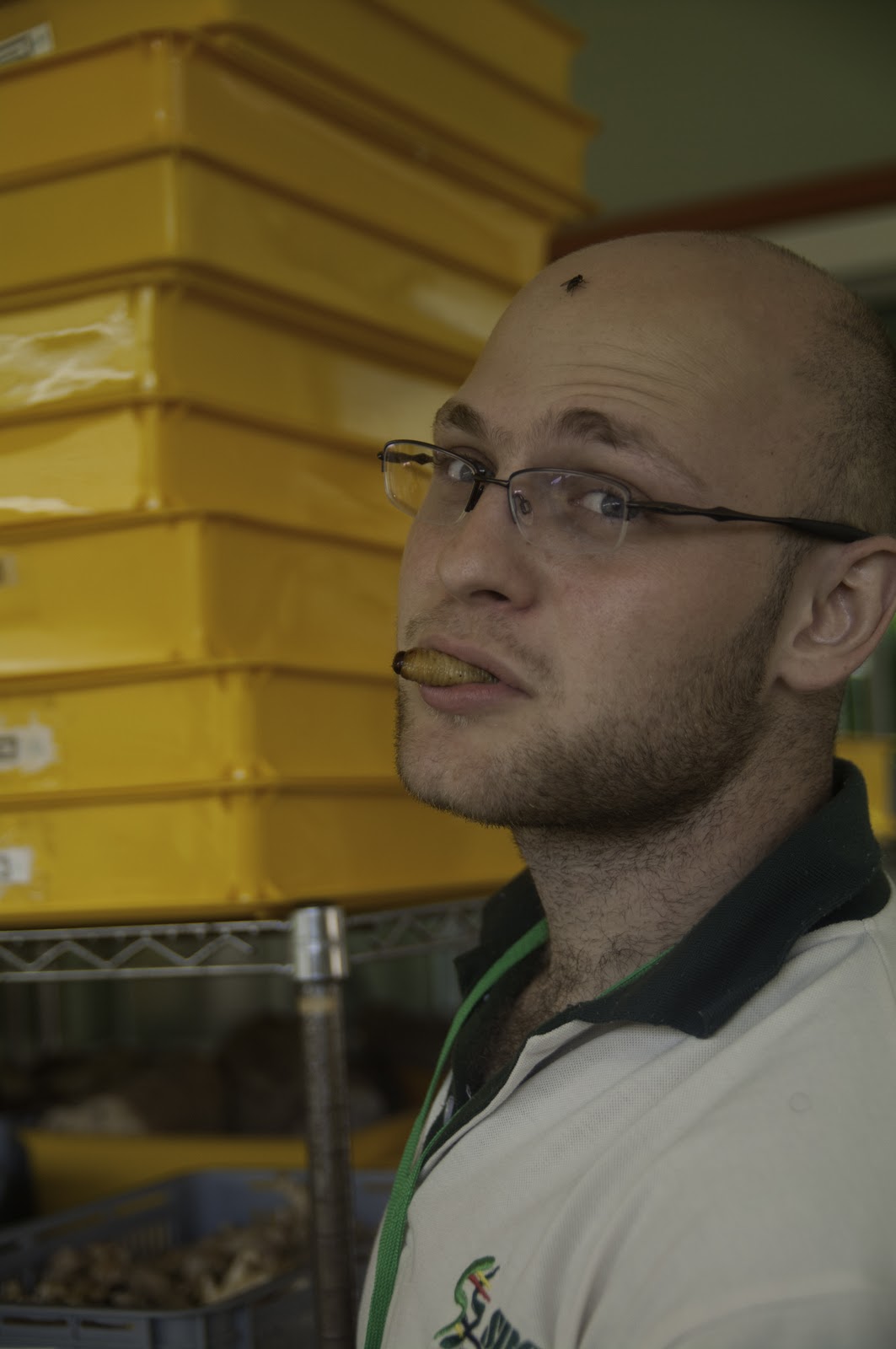
 Then I was called to the Extraction lab, where the research assistants there were stir frying some live Sago Worms. Why in the world do this in a chemical extraction laboratory? These worms, the grubs of larvae of Sago Palm Weevil (Rhynchophorus ferrugineus), thrive in the trunks of Sago Palm, and are regarded as a fine delicacy among many people here. They are considered clean and safe enough to eat live (so long as you wash them, and make sure to put them in tail first, pulling/biting off the head before fully munching on the body). Some horror stories exist and describe children just dropping in the worms whole, being victim to the burrowing abilities of the worm. The worms are often stir-fried for a bit before consuming, and in some cases with additions of Sago Flour, lemongrass, garlic, or bbq/terriyaki sauce. Stir frying the worms also helps to release all of their oils, which are thought by many people here to possess important medicinal applications. One belief is that their oil can regrow hair. Well, our extraction lab wants to begin the investigation of these reported properties, and so hence the stir frying action. And, well, I was called in to sample these slithery little beasts, an did so with just a little reservation. They ended up being quite nice, easy to chew, with the innards somewhat avocado-like in texture and taste. I would say fry those babies up in some garlic, oil, and salt, and you've won me over. I was told it was a mistake to not eat the head, as many say this adds some goodness to the taste and texture. I had a few ideas for dishes to incorporate these worms into:
Sago Worm Kebab
Sago Worm Potato Gnocci, with an alfredo sauce. Actually pesto could be even better. It's just that the worms look a lot like gnocci without the heads (and, like the moving around business) and somehow I see those flavors gelling really well together.
Sago Worm Fritters, with Chili-lime-honey dipping sauce.


Sago Worm Greek Salad. I think the mix of Feta, olives and worms could be a dynamite combo.
I gave some half-promises that I might try these worms live, before going back home. I'll let that idea simmer in my mind for a while before going through with it. I'm always afraid that my clumsy fingers might get me burrowed through, if you catch my drift.
I am very curious to find out if there is any merit to the claims about Sago Worm oil. I've been monitoring my hairline around the clock since my experience.
 Next, Gilbert and I were on the way home, when he noticed some people selling durians out of the back of their car, parked on the side of the road (Very normal thing to see) around 10 mile. He immediately made a U-turn and rushed back to get one. You see, this is a moment I've longed for for months. Normally durian season begins around December, but it has been very wet for this time of the year, so all fruiting seasons have been put out of whack. This one was expensive for durian in Kuching, selling at about RM20 (~$6), whereas they normally can go for way less (as low as RM1 in high fruiting season). I did not care one bit, nothing would stop me from having my first one. The man selling them opened one up to show off it's good quality (since otherwise there is no way of knowing whether the inside is rotted/overfermented/infested with larvae that got into the fruit during pollination). Back home, we cracked it open, and boy, was I psyched for this moment. I grabbed some flesh, just a bit creamy on the outside, and first took in the aroma. To me, it gave off a distinctive aroma, with almond and terpentine characters to it. Haters of the durian claim it smells of rotting onions, terpentine, gym socks, stale vomit, and many other unflattering odors. I was unfazed and actually kind of drawn to it, so I gave it a nibble. I think the look on my face told it all. I was in heaven. Gilbert immediately photographed my reaction, in which I think I teared from just how good it was. Imagine a very creamy almond vanilla custard with some flowery notes to it as well. I immediately gobbled down the rest and pursued more. I could not have been in a happier, satisfied mood thereafter. But then the burps started.
 Durians are well known for their easily fermentable nature, due to the microbes and high caloric content of the flesh (maybe the enclosed environment inside the fruit helps as well). They are known to cause some serious gas issues upon eating, can lead to some drunkenness if enough is eaten, and are often fermented into wines. They are called "King of Fruits" in Asia, because they are considered to be 'heaty' in how they affect the body. People report sweating quite a bit after eating them. But also people here know very well the potential dangers of mixing durian with other heaty foods, in particular alcohol. Other than the gassiness that can reach dangerous levels when the two are mixed, some studies have found that compounds in durian inhibit aldehyde dehydrogenase activity, which is needed to clear toxins of alcohol breakdown (http://www.newscientist.com/article/mg20327253.200-durians-and-booze-worse-than-a-stinking-hangover.html?DCMP=OTC-rss&nsref=online-news). Some old wives' tales may not be so mythical after all, but may hold some real truth that could save your life. To counteract the 'heatiness' of durian, some follow it with water, mint tea, or mangosteen, which is known as "Queen of the Fruits, " for its potent cooling qualities.

We did not, and instead went to have some tasty curry pan mee (though I did drink the cooling cincau, pronounced 'chinchou', drink). Then it was off to McGregor's Old English Pub to meet up with some other colleagues. We did not have so much durian that we needed to worry so much about mixing it with beers, but did still feel my body overheating. Also this is going to sound a bit strange, though not unusual for me, but I actually was really happy to be burping my brains out. It let me enjoy the taste and smell of the durian over and over again for like an hour or two.
You know some food left an impression on you if you actually want to burp to have another taste of it.
In talking about Durian, I mentioned this idea of heaty vs. cooling foods. This Chinese concept permeates the culinary landscape (and conversations about ailments) here in Kuching and in many other Asian countries. Basically the idea is that certain foods/ingredients contribute a 'heatiness' quality to the final dish (or when eaten by themselves are heaty), others are 'cooling', and some others are neutral, with a good balance of heaty and cool. This translates into the Chinese term for heaty (yang) meaning the set of physical or emotional symptoms one gets if heaty food is not well balanced by cool food. Cool (Yin), likewise stands for the set of symptoms one acquires having an imbalance of cool energy (see http://ezinearticles.com/?Heaty-and-Cooling-Foods&id=461430 for more). In many ways the symptoms make some sense from the concepts underlying them, as one might expect heatiness to lead to overactive metabolic rates, hyper-activated adrenaline response, and cholinergic type response (activating the parasympathetic system through acetylcholine receptors) of increased salivations and excretions; and overly cooling effects to lead to low energy/metabolic/behaviorally depressed states. Also interesting is that sometimes this characteristic of food can change upon specific types of cooking method (beef is neutral normally, but becomes heaty when deep fried).
I've been thinking that so many of my posts are about food, perhaps my blog should be retitled, "Lucid Eating". Then again, that would require me to be more health conscious here- something that is not really possible due to the cooking styles employed here. My only criticism of food is that it is too good and just does not inspire one any health consciousness, and basically no one is health conscious in the Western sense, though they are quite conscious of the heaty/cooling balance. There are few, if any, real health-conscious and still delicious food options. This is why the rates of obesity (6th highest in Asia, WHO), diabetes (4th highest in Asia, 80% increase in 10 years: http://www.mysarawak.org/2010/08/29/%E2%80%98sweet%E2%80%99-silent-killer-soars.html), hypertension/Cardiovascular disease are fast on the rise here. Another factor contributing to this is that city-dwelling people all have cars now and do not get much exercise. Bikers/runners are a rarity and are thought of as kind of quirky for wanting to get around this way, rather than by motor vehicle. I wonder if there could be better programs to inspire a love of exercise in more people. I still need to find out what type of health education and physical education schools provide kids at younger ages, because I'm unsure of what this aspect of education here looks like.
Friday the 28th turned out to be a big day for me in terms of food. I had stayed up late the night before, baking some amaretto coffee molasses cookies (in the end needed more amaretto because the taste was a bit lacking) as a Chinese New Year treat for everyone at SBC. I think I've mastered the art and science of making cookie dough (it's really really easy if you keep a few things in mind), but not the discipline needed to resist eating a substantial amount of it before baking. So cookies disappeared in no time; it seems word of free food gets around fast at SBC. That makes the baking all the more rewarding.

Sago Worm Kebab
Sago Worm Potato Gnocci, with an alfredo sauce. Actually pesto could be even better. It's just that the worms look a lot like gnocci without the heads (and, like the moving around business) and somehow I see those flavors gelling really well together.
Sago Worm Fritters, with Chili-lime-honey dipping sauce.


Sago Worm Greek Salad. I think the mix of Feta, olives and worms could be a dynamite combo.
I gave some half-promises that I might try these worms live, before going back home. I'll let that idea simmer in my mind for a while before going through with it. I'm always afraid that my clumsy fingers might get me burrowed through, if you catch my drift.
I am very curious to find out if there is any merit to the claims about Sago Worm oil. I've been monitoring my hairline around the clock since my experience.


We did not, and instead went to have some tasty curry pan mee (though I did drink the cooling cincau, pronounced 'chinchou', drink). Then it was off to McGregor's Old English Pub to meet up with some other colleagues. We did not have so much durian that we needed to worry so much about mixing it with beers, but did still feel my body overheating. Also this is going to sound a bit strange, though not unusual for me, but I actually was really happy to be burping my brains out. It let me enjoy the taste and smell of the durian over and over again for like an hour or two.
You know some food left an impression on you if you actually want to burp to have another taste of it.
In talking about Durian, I mentioned this idea of heaty vs. cooling foods. This Chinese concept permeates the culinary landscape (and conversations about ailments) here in Kuching and in many other Asian countries. Basically the idea is that certain foods/ingredients contribute a 'heatiness' quality to the final dish (or when eaten by themselves are heaty), others are 'cooling', and some others are neutral, with a good balance of heaty and cool. This translates into the Chinese term for heaty (yang) meaning the set of physical or emotional symptoms one gets if heaty food is not well balanced by cool food. Cool (Yin), likewise stands for the set of symptoms one acquires having an imbalance of cool energy (see http://ezinearticles.com/?Heaty-and-Cooling-Foods&id=461430 for more). In many ways the symptoms make some sense from the concepts underlying them, as one might expect heatiness to lead to overactive metabolic rates, hyper-activated adrenaline response, and cholinergic type response (activating the parasympathetic system through acetylcholine receptors) of increased salivations and excretions; and overly cooling effects to lead to low energy/metabolic/behaviorally depressed states. Also interesting is that sometimes this characteristic of food can change upon specific types of cooking method (beef is neutral normally, but becomes heaty when deep fried).
I've been thinking that so many of my posts are about food, perhaps my blog should be retitled, "Lucid Eating". Then again, that would require me to be more health conscious here- something that is not really possible due to the cooking styles employed here. My only criticism of food is that it is too good and just does not inspire one any health consciousness, and basically no one is health conscious in the Western sense, though they are quite conscious of the heaty/cooling balance. There are few, if any, real health-conscious and still delicious food options. This is why the rates of obesity (6th highest in Asia, WHO), diabetes (4th highest in Asia, 80% increase in 10 years: http://www.mysarawak.org/2010/08/29/%E2%80%98sweet%E2%80%99-silent-killer-soars.html), hypertension/Cardiovascular disease are fast on the rise here. Another factor contributing to this is that city-dwelling people all have cars now and do not get much exercise. Bikers/runners are a rarity and are thought of as kind of quirky for wanting to get around this way, rather than by motor vehicle. I wonder if there could be better programs to inspire a love of exercise in more people. I still need to find out what type of health education and physical education schools provide kids at younger ages, because I'm unsure of what this aspect of education here looks like.
Wednesday, January 26, 2011
monkeying around
Just a brief blurb about something I saw at a food court a week or two ago and more so my feelings on the matter. This Chinese man had a pet monkey (I think a Gibbon, but unsure), dressed in human clothes, chained by it's neck to him. When I saw it, my stomach felt literally sick with disgust and hate for that guy...it's weird, the type of physiological response I had...literally felt an unbearable mix of disgust, depression, and adrenaline fueled anger at this guy for enslaving a monkey. But then I got to thinking about this. And it still sucks, it's still terrible, just that I find it so strange how my mind and body responded to a primate being chained up in this way, while dogs on leashes, cats in a purse, hamsters in cages, etc. get nothing in the ways of remorse in most cases. Actually they often get the opposite response, as in many case I and most other people would come up to pet a cute looking dog. You see you can always rationalize something like this, but I feel like the physiological response is the real tell of how we feel at our core, so to speak. All of our internal, hidden, biases come out. Or maybe it's just memories tied to emotionally charged experiences we have earlier in our lives.
So, does our body decide to react in this way based on evolutionary understanding? That monkeys are sort of evolutionary cousins (or maybe uncles, i really forget how it works) to us, while non-primate mammals are more like 3rd or 4th cousins...does our mind feel some sort of special remorse for monkeys based our own anthropomorphic fantasies? That because it peels a banana with its fingers and can learn how to use a currency system (Super Freakanomics) it must have some secrets to our own behavior and culture, meaning in some senses we are enslaving one of our own? And if that's the case you would think all mammals would get that remorse, with the whole breastfeeding business.
I wonder what percent of people would have a physiologically negative response to seeing what I saw or seeing any animal on a leash, and for those who respond in such a way, when is it programmed for us to react in such a way? When is remorse for other animals developed? Is it a learned reaction based on increased learning of our relationships to these primates?
Well, just some thoughts I've been having. Becoming aware of these feelings definitely made me feel guilty for how ok my body (though not my mind) is with seeing some animals on a leash, while others (I don't do so well at zoos unless I know the animal's population is being rehabilitated by the zoo after overhunting in the wild) produce such a strong response. This might sound like the weirdest thing to wish for, but sometimes I do wish i felt a guttural, physiological sickness at the sight of any any animal (and not just primates) that is somehow restrained/chained by people.
Friday, January 21, 2011
The art and science of jungle trekking
I first thought about writing this post in October, when I was trekking up in the Bornean Highlands in the swampy Montane/Submontane forests of Paya Maga. I noticed that the others in my group seemed to know the importance of a walking stick and knew exactly how to pick out the best one. Then I've noticed and have been to seriously revere the trekking abilities of people here. I'm so impressed by some of the people (mostly the 'indigenous' groups, but definitely other like Malay and Chinese) here navigate the rainforest. it's beyond just a familiarity one might gain from doing something day in and day out. It's a feel, a sixth sense, almost as if they can listen to what words of wisdom the rainforest can offer them. It emerges also out of a deep reverence for the biodiversity and beauty this place holds. And with these skills, they are able to maintain a keen eye for potentially dangerous animals (or dinner) hiding nearby. Or quickly climb a tree to grab at a nutritious midday snack. Or just run through the forest (regardless of steepness or obstacles), instead of inching ahead sluggishly like I do.
I think throughout the rest of the year, I will try to compile in this post the various lessons I've learnt about jungle trekking. Even if I cannot exactly follow these important lessons.
I think throughout the rest of the year, I will try to compile in this post the various lessons I've learnt about jungle trekking. Even if I cannot exactly follow these important lessons.
1. Every step you take, do it with confidence. Don't be a helpless victim of your feet, just strolling away carelessly. Put some thought into your steps (Be Mindful and Aware of surroundings, especially the ground beneath you). Otherwise you might end up falling through some weak spots in the trail, or just tripping up and falling to a precipitous death. Basically every other less I've learned follows from this advice, and should be more or less obvious.
- If you're uneasy about a step, surely your feet will not be stable and in general you are more likely to slip or lose balance
- If you can be confident about step, then hopefully it means you have assessed whether the ground/rocks you are stepping on will remain stable under your weight.
- Even though you are confident about the step, if are going downhill, make sure you keep your weight back. definitely commit to the step, but you also don't want to destabilize yourself by moving from your center of gravity.
2. See each step you take long before you take it. Do not just walk constantly looking down, but rather see the steps you'll be taking some distance in front of you, so you're mind and feet can plan. Also that way you'll avoid walking into trees, people, snakes (cleverly disguised as roots under your feet, WHAT??!!!) waiting to attack. You should also avoid playing iPhone games or texting while on the trail.
- this is really an extension of being mindful and aware of surroundings. It takes time, but you'll need to be able to assess the entire scene around you. This will help you plan out each step, for example, whether it's ok to grab onto that tree (you should ask yourself: Will that tree hold my weight and extra tug I'm going to give it? as well as Does the tree have some sharp spines or dangerous critters lurking in it?) to boost yourself with.
- in general avoid grabbing things you have not thoroughly investigated yet. This should be a piece of advice followed by every living thing on Earth, but especially humans, who seem not to have entirely internalized this lesson.
3. Natives who jungle trek everyday dont have much use for walking sticks, but they can be useful at times, if only to beat down some quickly approaching danger.
- Of course the stick needs to be appropriate for your height, and should be of a sturdy material, and flexibility of any kind is strongly discouraged for your stick.
- There is a 'right' way to use a walking stick, so that it becomes your best ally rather than just a random piece of wood you're lugging for no good reason.
- It might seem surprising, but there are commercially sold walking sticks that look quite a bit like skiing poles
- I had this thought the other day: There really should be multipurpose walking sticks. why not have a walking stick that is also a tripod/monopod for a camera that can also have a pop out knife at the push of a button? There could even be paddle adaptors in case you need to make a raft and paddle across some water.
4. Try to develop the jungle sense
- I cannot quite convey how this is done, since I have yet to acquire it, but the natives seem to develop this innate sense for where is safe to go in the jungle
- They can often tell which path will lead them in the 'right' direction, or can tell if, say the base of a waterfall is rocky or clear (without actually going in to test it out)
- Probably growing up in a jungle helps a lot, but for us outsiders, getting a 'sense' for the jungle means understanding the potential signs of danger ahead (weak patches of ground; dark, calm pools of water suggest absence of rocks; shed skin of snakes lying around might indicate a snake's proximity)
- Also spending more time in rainforests can help one develop the 'eye' and 'ear' of a good jungle trekker. This means being able to spot organisms; whether big or small, breathing or photosynthetic, cloaked by leaves or other objects, or hidden in enclosed crevices or perched atop trees.
5. Follow jungle etiquette
- There is a widely held belief among the people here that living, sentient, forces pervade the fabric and ever object within the forest. This has serious implications for how one should conduct him/herself while in the forest.
- For one, any type of littering will anger the forest spirits and can lead you to either get lost in the jungle forever or to encounter some very dangerous animal that could mortally injure you
- Another thing to keep in mind is to 'ask permission' from the jungle spirits before making the jungle your own personal toilet bowl.
- Moreover, shouting is discouraged for similar reasons of upsetting jungle spirits.
- Lastly, it is thought that uttering the name of certain organisms common to the jungle (i.e. poisonous snake, leopard) might actually summon those animals to confront you. So unless you want a cobra on your ass, don't say "Cobra".
Ok, I'll be updating this post as I find out more on these very important topics.
Saturday, January 15, 2011
Friendly Neighborhood Spider
First off, I have so many half-written posts and well, one of these next few days, I 'm hoping to finish them. I guess I'm in a bit of a slump in my time here. Part of it is how much I enjoyed being back home in my month long interview 'circuit'. And having to leave again has been a little hard on me, since my first few months in Borneo really made it clear to me how lucky I am to have all the family and friends that I do. In some senses the 'newness' of Kuching is fading away, as I've become familiar with customs, the way of life, food, more food, and the mentality here. Don't get me wrong; I still love it here and am enjoying myself, just that it's requiring a little more initiative from me to seek out cool new experiences. I'm craving trips to some new places, but the monsoon season is at odds with that. Instead of spreading out my travels, they'll all come in a few grand trips (March is going to be a big traveling month), when the weather has improved. To try to combat this slump, I'm trying to look out for new and exciting experiences or sights in daily life here.


It turns out I need not look beyond the front gate of Gilbert's driveway. Early this week, we found this ~3 cm long (body) neon yellow giant propped comfortably against it's unique web. Though it was no Acromantula, this one seemed pretty big as far as I've seen here. What was cool were some white strips on its body that seemed to glow in the dark (In the end, those strips turned out to just be very light reflective). I brought out the tripod and started snapping away. Since it was already dark, I took out the flash, and then also experimented with the UV lamp. It turns out most spiders' bodies glow or are fluorescent under UV. The next day the spider changed sides, and then the day after moved to the other side of the gate. What's amazing to me is how the web was completely gone where the spider had been the night before. And then for some reason, the spider just went back to its original position the next day. I wonder if it breaks down that original web and completely remakes it? And what's the stability of the web once it is spun? Can the spider adjust the strength and elasticity of the web according to the environment? I assume yes (because insects are just that amazing), but wonder how the spider even senses the environment and consciously affects it's own biochemistry. I clearly should have taken an entomology class because I have a soft spot in my heart for insect biology. As long as they keep their greasy, slimy legs off my chocolate souffle.


 |
| Spider under some short wave UV light |
Subscribe to:
Posts (Atom)